CLASSIFIED CONTENT
April Fools' Day didn't use to be this chaotic. What started as lighthearted newspaper hoaxes has mutated into a high-stakes arena of AI voice clones, hyper-realistic fake renders, and corporate marketing teams trying way too hard to go viral.
Here is how we went from innocent medieval confusion to full-blown digital paranoia.
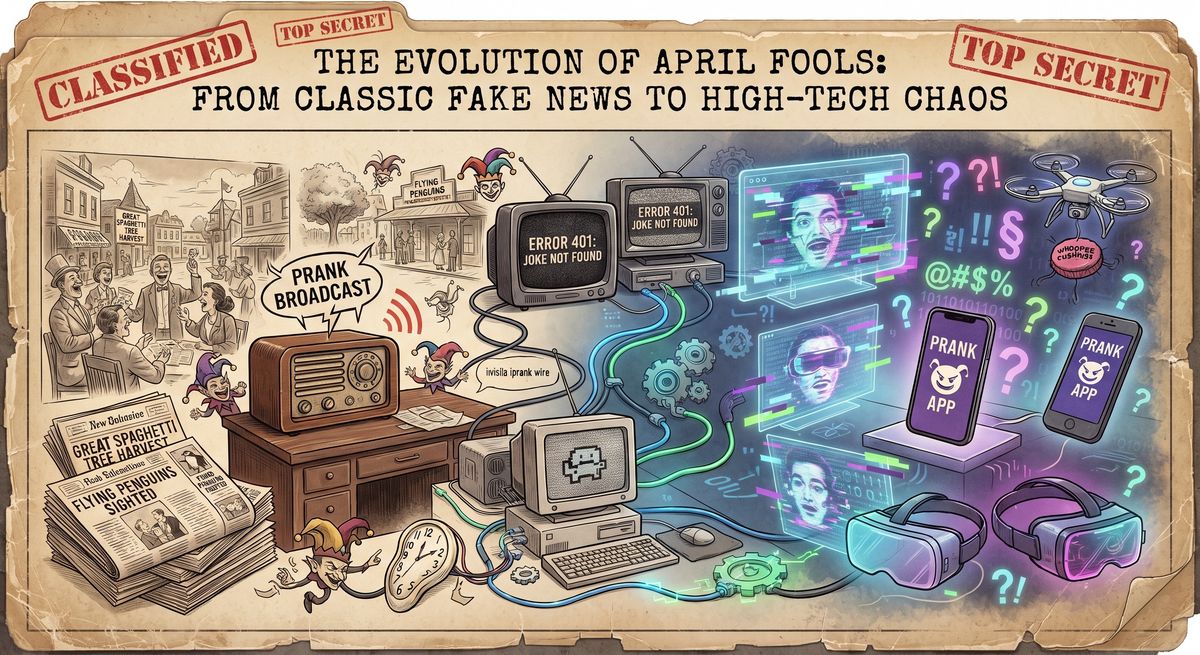
The Low-Tech Era: When People Actually Believed Everything
Before smartphone screens and instant fact-checking, pulling off an April Fools prank required patience and a serious straight face.
Back in 1957, the BBC aired a short news segment showing Swiss farmers harvesting spaghetti directly from trees. Millions of viewers completely bought it—some even called the station asking how to grow their own spaghetti bush. In the 70s and 80s, newspapers would quietly sneak a fake story onto page four, like a bogus scientific breakthrough or a local law ban, and wait for readers to call in furious.
The charm of these classic hoaxes was simplicity. People trusted major media outlets implicitly, so the moment a official-sounding voice delivered ridiculous news, everyone lost their minds.
The Golden Age of Corporate Internet Trolls
When the web went mainstream in the late 2000s, April Fools became the ultimate battleground for corporate marketing teams.
Google was arguably the undisputed king of this era. Remember Google Paper (promising to print your emails and snail-mail them to you) or Google Maps' 8-bit NES mode? Brands realized that making a surprisingly high-budget fake product was the fastest way to get free press and millions of social shares.
For a good decade, the formula was predictable:
- Pick an absurd feature nobody asked for.
- Produce a 4K commercial with dramatic background music and serious engineers.
- Drop the link at midnight on March 31st.
It was cheesy, but it worked because companies were competing over who could be the most creative—not who could cause actual confusion.
The High-Tech Chaos Era: Deepfakes, AI, and Instant Paranoia
Fast-forward to today, and April Fools' Day hits totally differently. The joke isn't always funny anymore—sometimes it's just terrifyingly convincing.
With generator tools producing near-flawless AI images and voice clones, the line between a harmless prank and flat-out fake news has basically disappeared. A brand posts a slick AI-generated photo of a shoe line collaboration, and before anyone spots the subtle "April 1st" text in the caption, three sneaker blogs have already written full articles about it.
Add smart doorbells, instant group chats, and deepfake audio to the mix, and modern pranking feels less like a silly tradition and more like psychological warfare with your friends.
When anything can be forged in ten seconds with a prompt, people stop believing actual real news that drops on April 1st too.
Why Simple Pranks Still Win
Despite all the high-tech AI chaos, if you look at Reddit or TikTok on April Fools, the pranks that get the best reactions are still the low-tech classics.
A simple Sitting Statue jump-scare on a porch, a clever sponge ball switch, or sticky-noting someone's desk gets genuine, unfiltered laughs every single time. High-tech hoaxes might get clicks, but physical, human-level humor is what actually stays memorable.
At the end of the day, a great April Fools prank shouldn't feel like a scam—it should leave the person being pranked laughing right along with you.